BUILT FOR THE BOTTOMS.
Work the wind.
Read the water.
Choose a river bend, flooded cypress swamp or open marsh. Change the banks, water level and cover, then work your spread.
A free, hands-on planning experiment.
No account needed to play.
SPREAD CHECK
An open invitation.
IN THE WATER
Precise placement & keyboard controls
Select a decoy below. Move it with arrow keys on the map (1 yard; Shift = 5), or enter coordinates. Delete removes the selected decoy. Coordinates: yards east and north from the fixed map origin; the blind can move independently.
THE HOME BASE
Built for the Bottoms.
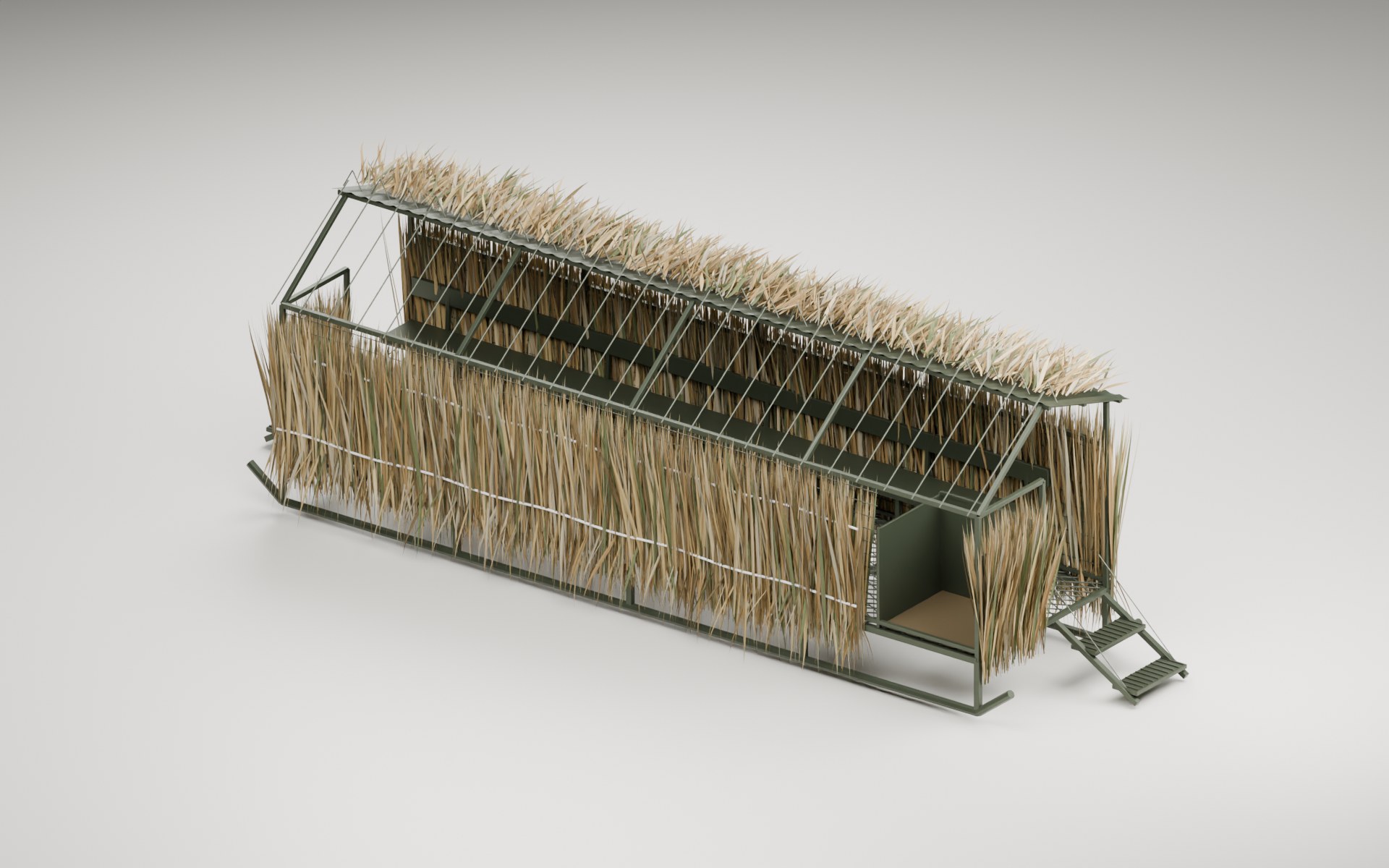
A look at the Languille blind, brushed in with dry marsh grass. Explore the structure underneath in the short assembly visualization.
Concept renders based on supplied shop photographs. Details and camouflage are illustrative.
Look inside the blind · 12 second film
READING THE WATER
Experiment.
Observe. Adjust.
This is an interactive scenario simulator, not a validated wildlife forecast. Wind, pocket clearance, bank crossings, ice and selected wariness assumptions affect the example approach. Real ducks can respond differently. Bird type changes silhouette, size and wingbeat animation; it does not claim species-specific attraction probabilities.
The freeze/thaw model uses air and starting water temperature, prior cold duration, depth, current, snow, initial ice and elapsed hours. A shore-first pattern visualizes the resulting ice index; a maintained hole keeps a circular area open. The index is a simplified design assumption, not measured ice coverage, thickness or load-bearing capacity. Never use this model to decide whether ice is safe.
Choose a neutral, curious or wary response to motion, then adjust hunting pressure, concealment and calling. These are explicit scenario assumptions, not fitted biological relationships. No harvest probability is calculated. Habitats are generated scenes, not surveyed locations. River width and water level reshape the banks; swamp trees and islands affect clearance checks. Currents are illustrative and decoys are treated as anchored. Migration, food availability, salinity, real bathymetry, thermal radiation, individual learning and scouting observations are not yet modeled.
Field references & equipment examples
- Ducks Unlimited: ice and open water
- National Weather Service: factors in ice formation
- Ducks Unlimited: decoy basics
- Ducks Unlimited: classic spreads
- Ducks Unlimited: motion decoy strategies
- MOJO: spinning-wing example
- Higdon: water-motion example
Generic categories only; not a complete market catalog. No affiliation or endorsement. Check local rules before using motorized decoys.